Showing posts with label skriving. Show all posts

Tuesday, 28 December 2010

notes on Roland Barthes

The Preparation of the Novel
(Columbia, N.Y, 2011)
Session of December, 2, 1978

... for someone who writes, who has chosen to  write, that is to say, for someone who has experienced the jouissance, the joy of writing, there can be no other Vita Nova (or so it seems to me) than the discovery of a new writing practice.
(Preparation... p. 5)

Friday, 24 December 2010

stack of books

 I got lots of books in the mail last week, the plan is to get to read some of them during the holidays. From top to bottom:


  • César Aira: Ghosts
  • César Aira: The Literary Conference
  • Phillip Lopate: Notes on Sontag
  • Harry Mulisch: The Assault
  • John McGahern: Love of the World
  • Jenny Erpenbeck: The Old Child & The Book of Words
  • Jenny Erpenbeck: Visitation
  • Phillip Lopate: Against Joie de Vivre
  • Damon Galgut: In a Strange Room (Reading this one on my iPad, so the actuall book will go as a gift...)
  • Roland Barthes: The Preparation of the Novel
Last night I had a look in Lopate's Notes on Sontag, and in the introduction he clearly introduce her as a much better essayist than novel writer. Lopate is a reliant expert in the essay genre, and I have no doubt his judgement is right. But Sontag herself would definitely disagree (if she had had a chance - ). To her the novel always came before the essay.


On page 17 Lopate cites a rather harsh comment from Barthes on Sontag's work. Again I believe that it is primarily the fiction writing Sontag that are judged to not be strong enough. 

Isn't it both strange and a bit sad that she can't be satisfied with being an excellent essay writer? 


And isn't it also very interesting that this harsh critique comes from a man who himself was a great essayist wanting to become a novelist?!

I guess this is not the only question waiting for me in this stack of books ...

ps

many of you who visit this blog already know: 
i'm a Norwegian writer & critic
all my professional texts are consequently written in Norwegian.
(all the English stuff is just for fun...)
Are you interested in any of my professional work you can have a look here:


Sunday, 12 December 2010

Judith Schalansky

I’ve been working on some short stories for a while. They are all set in a very ordinary everyday setting: A day at the beach, a family dinner, a morning walk, etc. 

But then suddenly, to my surprise, one of my stories demanded to take place on an ice raft in the Arctic Ocean somewhere between the North Pole and the Russian tundra.


No wonder then, that I immediately fell in love with Judith Schalansky’s Atlas of Remote Islands. Fifty Islands I have not visited and never will. The title in itself is really enough to make one marvel!
A great review of the book can be found here.

Judith Schalansky’s book is a very fine mix of facts and fiction, as she her self states in the foreword, fact and fiction cannot - if truth be told – ever be separated:
Those who discovered the islands became famous, as if their achievements related to an act of creation, as if they had not merely found new worlds but actually invented them … only that which is written about has really happened.
Of Peter I Island in the Antarctica, she writes:
It was only in 1929 – 108 years after its discovery – that it was landed on, and until the 1990s more people had set foot on the moon than on the island.


 Schalansky’s book truly conveys the world in all its strangeness.


And her drawings -; delicate, precise and mysterious.


Go ahead: read it!

Saturday, 11 December 2010

foundation

If I am to make a list of the works that are most important to my own writing just now, it would look approximately like this:

Primary foundation

  • Annie Dillard: Teaching a Stone Talk, Living by Fiction
  • Helle Helle: Hus og hjem, Ned til hundene
  • Thoreau: Walden
  • Sara Maitland: A Book of Silence
  • Judith Schalansky: Atlas of Remote Islands - Fifty islands I have not visited and never will


Secondary sources

  • Bill Bryson: At Home
  • Bachelard: The Poetics of Space
  • Lopate: The Art of the Personal Essay
  • Johnstone: The Everyday
  • Carol Shields: Unless

Possibilities - not yet read
Marilynne Robinson: Home, Gilded, Housekeeping
This is why I want to read Robinson:
The small town of Gilead, in which two of Marilynne Robinson's three novels are set, is "a dogged little outpost" in Iowa, where her characters live modestly and scorn themselves for staying put. They don't go anywhere, do anything, see anyone besides their neighbours, and the town itself doesn't change - an odd choice of set-up for a novelist, but one that permits her to make a suggestion: that it is people in their kitchens, devastating each other softly and for the most part without intent, that constitutes life at its most indivisible.

silencing the world

"The writer studies literature, not the world. She lives in the world, she cannot miss it. She is careful of what she reads, for that is what she will write. She is careful of what she learns, because that is what she will know."
Annie Dillard


This morning I heard a very interesting interview on NRK P2 - (radio), a journalist talked to the author Hanne Ørstavik about being disconnected from the media-world and www. As some of you already know, I am out on a quest for silence and solitude, and believe that these qualities are necessary for being abel to listen to oneself - which one must, if one really wants to write. In the interview Ørstavik told us that she listen to P2 in the morning, and then read the newspaper Klassekampen when having her breakfast, these two were her only daily media intake; no facebook, no twitter, no surfing ...

Its a great challenge to silence the twaddle and empty words of the world, actually it is impossible for one who is not a hermit or a nun! But its is important to try minimize the external noises to make some space for oneself. What is the point of living if one cannot hear ones own voice? 


Sunday, 5 December 2010

time to tidy up!

 We had a great party for TK last night, so no surprise the house looked ... well; let me put it this way: very well used ... this morning. After tidying living-rooms and kitchen I continued into my study
The main problem in this room is lack of shelves. To give myself some more space I removed all the books I have review this year into a shelf in the hall
As you can see the desk isn't quite cleared yet. I feel like my head is clearing up as I sort out my books and notes - giving room (physical and mentally) for new thoughts
My reading-chair looks ready for new hours with me and my books
To get some peace and quiet I've put a warning sign on my door, it says: Hush! Work in progress. Visiting hour 12:00-13:00. Please do not disturb. The line in the middle says: new brewed coffee welcome at all hours (professor TK has become an excellent barista lately)

On a second note, just underneath my own, my son has written: April fool - hm... (seems like there might be a slight authority issue here???)

Friday, 26 November 2010

on silence

I’m letting myself be guided by literature, and today my readings of Annie Dillard and Thoreau have led me to Sara Maitland. In her Book of Silence (2008) she writes:

We have reached a point contemporary Western culture where we believe that too much silence is either ‘mad’ (depressive, escapist, weird) or ‘bad’ (selfish, antisocial) and I found I had internalised quite a lot of this way of thinking (24-25)

And so have I… 
I think much of my interest for the above mentioned authors stem from an impression of them being writers who both see the need for, and also cherish, the individuals need for silence and solitude. 

Saturday, 20 November 2010

Walking

I think that I cannot preserve my health and spirits unless I spend four hours a day at least — and it is commonly more than that — sauntering through the woods and over the hills and fields absoutely free from all wordly engagements. You may safely say a penny for your thoughts, or a thousand pounds. When sometimes I am reminded that the mechanics and shop-keepers stay in their shops not only all the forenoon, but all the afternoon too, sitting with crossed legs, so many of them — as if the legs were made to sit upon, and not to stand or walk upon — I think that they deserve some credit for not having all committed suicide long ago.

Friday, 12 November 2010

simple living

There are seven or eight categories of phenomena in the world that are worth talking about, and one of them is the weather.


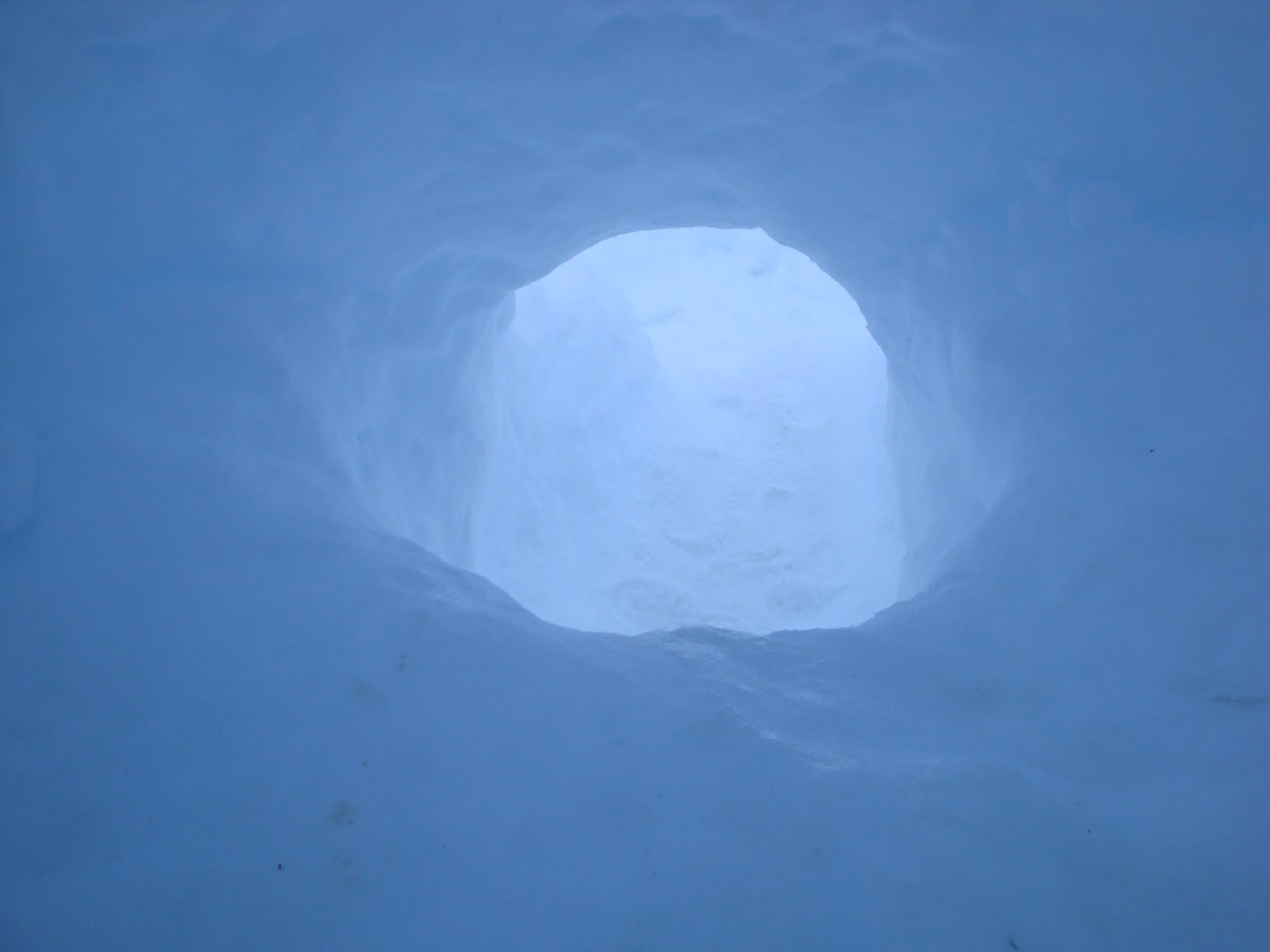
Interior of an igloo, facing the entrance

Thursday, 11 November 2010

on reading

I'm reading slowly these days, reading Tinker Creek and Walden at the same time, page by page, word by word. Using all kinds of dictionaries and encyclopedias to widen my understanding.

Its like a dream.

"The writer studies literature, not the world. She lives in the world, she cannot miss it. She is careful of what she reads, for that is what she will write. She is careful of what she learns, because that is what she will know."

A.D

But you cant fail to see the close relationship these two both have to nature...

"… I am no scientist. I explore the neighborhood."

Sunday, 7 November 2010

on writing

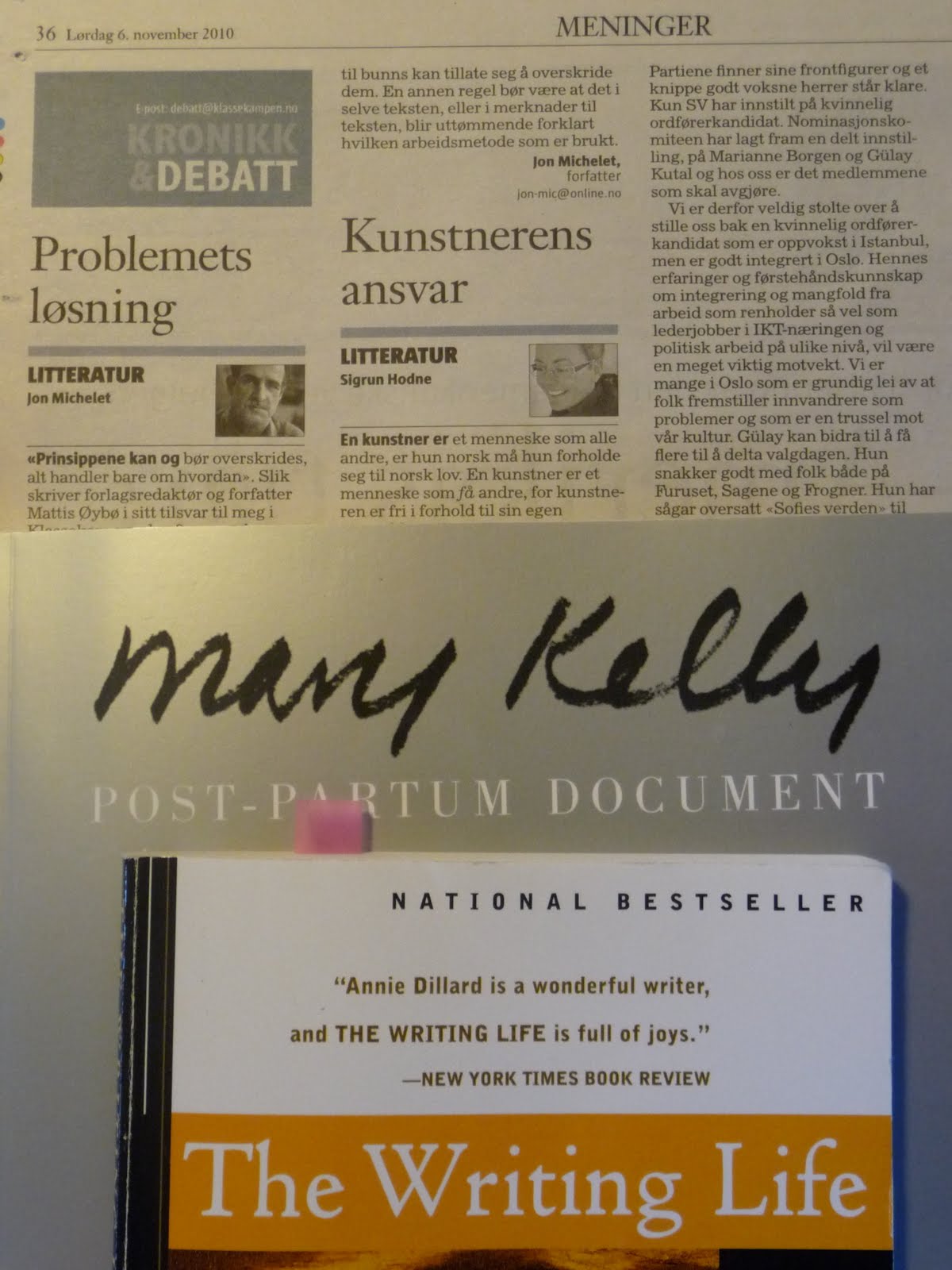
Yesterday I had a short comment in a national newspaper called Klassekampen. My text was a critique of some comments made on literature and reality by professor Tjønneland earlier this week. He is afraid that contemporary writers are constructing an informant society because they write about live and living models.

I don't see this as a problem, the art that interest me the most is very often connected very close to the everyday life of the writer or artist. Thats one of the reasons for my engagement with artists like Annie Dillard, Thoreau, Montaign, Helle Helle, Tomas Espedal, Sophie Calle and also Mary Kelly - who I will be "visiting" in Stockholm next week.

I do not believe in the idea that the artist is or should be disconnected from the everyday life.
Here is my text:

Kunstnerens ansvar

En kunstner er et menneske som alle andre, er hun norsk må hun forholde seg til norsk lov. En kunstner er et menneske som andre, for kunstneren er fri i forhold til sin egen tematikk og metode. En kunstner er ikke hevet over loven, men friheten setter henne i en særstilling som gjør det mulig å utforske og utfordre lovens rammer og begrensinger. Å være maktkonfronterende og å utfordre samfunnets moralske konvensjoner er, og har alltid vært, en av kunstens viktigste oppgaver.

Under overskriften «Går mot Stasi-samfunnet» (Klassekampen torsdag 4. november) bekymrer professor Eivind Tjønneland seg over virkelighetssuget i litteraturen. Han påstår at forfatterne i verdens frieste land mimer et totalitært samfunn fordi de i sine bøker skriver om virkeligheten og om virkelige mennesker. «At man ikke skal kunne gjøre noe uten å risikere å bli publisert i en bok, er ingen tjent med» sier han. Vel – vel. Stasisamfunnet var, så vidt jeg vet, mer kjent for sensur enn for kunstnerisk åpenhet.

Hvis det stemmer at virkeligheten er til stede på en ny måte i samtidslitteraturen kan det være interessant å forske på hvorfor, Tjønnelands moralske indignasjon har imidlertid ingenting med forskning å gjøre. Kunsten kan ikke forholde seg til god takt og tone. Noen ganger er det til og med slik at der er nettopp overtredelsen av loven som gjør et verk kunstnerisk interessant, ikke dermed sagt at man kan gjøre det ustraffet.

Hva er mest stasi-aktig, å gjenskape sin egen subjektive virkelighet på papir, eller å la forskere, redaktører og journalister definere hvilke tema som skal skrives om?

Sigrun Hodne

Litteraturviter, kritiker og skribent

Friday, 5 November 2010

on the shore of vastness

I was loosed on the shore of vastness. There was no continental shelf. I lived on the beach. The brink of the infinite there was too like writing’s solitude. Each sentence hung over an abyssal ocean or sky which held all possibilities – as well as the possibility of nothing. The twilight lingered till dawn. The wide days split life open like an ax.

Annie Dillard

Thursday, 4 November 2010

november


on writing


Writing sentences is difficult whatever their subject. It is no less difficult to write sentences in a recipe than sentences in Moby-Dick. So you might as well write Moby-Dick.
Annie Dillard: The Writing Life

Sunday, 24 October 2010

planning for the future


I'm planning a trip to Stockholm in the middle of November, where I'm going visit Mary Kelly's exhibition at Moderna Museet. Last time I saw her work was at Documenta. I find her artistic research (I believe this is a suitable way to describe how she works) very intriguing.

My days in Stockholm will be dedicated to Kelly (plan to do some writing on her work), if time allows I will also visit the Anna Duncan exhibition at Dansmuseet.

Monday, 11 October 2010

Wednesday, 29 September 2010

first frost

Vera gave me a great tips yesterday, and while waiting for Mr. Birkhead's The wisdom of birds to arrive I am studying the first frost.


This morning there was frost on the Dogwood bushes, I hadn't brought my camera so I have to borrow a picture from the net, but this is absolutely what it looked like First frost on dogwood


dogwood |ˈdôgˌwoŏd|

noun

a shrub or small tree of north temperate regions that yields hard timber and is grown for its decorative foliage, red stems, and colorful berries.

ORIGIN so named because the wood was formerly used to make “dogs” (i.e., skewers).

Tuesday, 28 September 2010

The Writing Life

I have mentioned it before, I'm really not that much into nature, but these days it seems as if nature is into me ... it pops up everywhere I look, it's all very strange. I better start listening -
"Asteroidea" from Ernst Haeckel'sKunstformen der Natur, 1904

Friday, 10 September 2010

"I’m tired, and all I want to do now is read"


I enjoy my work more than ever, but must admit that I, in the rush of exhibitions and new books filling my autumn days, long for peaceful hours with my favorite authors, e.g.: Annie Dillard


Pulitzer winner Annie Dillard’s second novel, The Maytrees, came out in 2007. She’s written over ten other books, but she says The Maytrees, her first book in eight years, will probably be her last. “I’m tired,” declared the 62-year-old Dillard, who says that she won’t be doing any more touring, public readings, blurb writing, or letter answering. “I worked so hard all my life, and all I want to do now is read. I’m glad to go out on this book,” she says. (The Maytrees tells the story of two married artists in Provincetown, Massachusetts, after World War II.) She did mention one, possibly tongue-in-cheek idea for further work: “To take all my never-used metaphors and just throw them up in the air for other writers to use.” Grab Bag, by Annie Dillard? “I like the title Free-for-All,” she says.

(Dillard has told Publishers Weekly that the first draft of The Maytrees was 1,400 pages long and that she ruthlessly cut the manuscript down section by section, character by character, syllable by syllable, until only 216 pages - nothing superfluous - remained).